
Complex PTSD develops after repeated or prolonged trauma and often resists standard talk therapy and medication.
Ketamine for complex PTSD works differently, calming an overactive fear response and boosting neuroplasticity so trauma processing becomes more accessible, especially when paired with psychotherapy.
Research shows meaningful symptom reduction for many patients, though it is not a cure and works best as part of a broader treatment plan supervised by a medical provider.
If you have lived with complex PTSD, you already know that standard treatment does not always reach the parts of you that feel stuck.
You may have tried therapy, medication, or both, and still feel trapped by shame, emotional swings, or trouble trusting people.
Ketamine for complex PTSD is gaining attention as an option for people in exactly this position, especially when traditional approaches have not provided lasting relief.
This guide looks at what complex PTSD actually is, what the research says about ketamine for PTSD, and what treatment looks like for people in Mesa, Arizona and the greater Phoenix area.
What Is Complex PTSD and How Is It Different From PTSD?
Complex PTSD (often written as C-PTSD) develops after trauma that happens repeatedly or over a long period, such as childhood abuse, ongoing domestic violence, or prolonged captivity, rather than a single traumatic event.
It includes the same core symptoms as PTSD, plus three additional struggles that make daily life harder to manage.
The World Health Organization’s ICD-11 framework describes these three additional struggles as disturbances in self-organization: trouble regulating emotions, a persistent negative view of yourself, and difficulty forming or keeping relationships.
Someone with complex PTSD might swing between emotional numbness and sudden intense reactions, feel fundamentally flawed or worthless, and pull away from people who genuinely want to help.
These symptoms frequently show up alongside anxiety and depression, which can make it harder to pinpoint exactly what is driving the distress and harder still to treat with a single approach.
How Does Ketamine Help With Complex PTSD?
Ketamine works differently than antidepressants or talk therapy alone.
Instead of targeting serotonin, it acts on the brain’s glutamate system by temporarily blocking NMDA receptors.
This appears to quiet an overactive fear response and trigger rapid growth of new connections between neurons, a process called synaptogenesis.
The result is a short window, usually lasting a few days after a session, where the brain may be more open to new learning and less locked into old trauma patterns.
That window is why many providers pair ketamine with focused psychotherapy rather than offering it as a standalone treatment.
It is also part of why ketamine is being studied for the broader benefits of ketamine therapy across several mental health conditions, not just complex PTSD.
Why Complex PTSD Often Resists Traditional Treatment
Standard treatments for post-traumatic stress disorder were largely developed with single-incident trauma in mind.
Talk therapy and trauma-focused approaches like EMDR often assume a baseline ability to regulate emotions, which is exactly what complex PTSD disrupts.
Antidepressant medications that target serotonin can take four to six weeks to show any effect, and many people with complex PTSD have already tried several before finding limited relief.
Exposure-based therapies, while effective for many people, can also feel overwhelming or even re-traumatizing without a strong foundation of emotional safety first.
This gap between what traditional treatment offers and what complex PTSD actually requires is a major reason researchers have turned toward faster-acting, neuroplasticity-based approaches like ketamine.
What Does the Research Say About Ketamine for PTSD?
A review of 26 studies published in Therapeutic Advances in Psychopharmacology found encouraging signals of both safety and effectiveness across case reports, open-label studies, and randomized controlled trials.
Case studies reported improvement in 44 to 86 percent of patients, and open-label studies showed large effect sizes.
A single ketamine infusion produced a 12.7-point reduction in PTSD severity scores compared with a control, and repeat dosing across six infusions produced a 67 percent responder rate.
Clinical Trial Findings
A randomized trial at the Icahn School of Medicine at Mount Sinai compared a single ketamine infusion to an active control in 41 participants with chronic PTSD.
Seven days after treatment, the ketamine group showed lower symptom scores on both the Impact of Event Scale and the Clinician-Administered PTSD Scale than the comparison group, suggesting rapid relief of core PTSD symptoms.
Yale Medicine is currently running a 7-day intensive trial that pairs ketamine with prolonged exposure therapy, giving low-dose infusions alongside trauma-focused sessions and tracking changes in brain connectivity between the amygdala, hippocampus, and prefrontal cortex, the regions most affected by chronic trauma.
Combining Ketamine With Psychotherapy
A systematic review that pooled patient-level data across multiple ketamine-assisted psychotherapy trials found that pairing ketamine with structured psychotherapy produced more consistent results than ketamine infusions given on their own.
Separately, a large retrospective study following patients for six months after ketamine-assisted psychotherapy reported sustained improvement in PTSD, anxiety, and depression symptoms well beyond the treatment window.
Is Ketamine Safe for Complex PTSD?
Ketamine has a generally favorable safety profile when given in a medically supervised setting, with no serious adverse events reported across most of the trials reviewed above.
Side effects like dissociation, mild nausea, or a temporary rise in blood pressure are usually transient and resolve within one to two hours.
There is one nuance worth taking seriously for people with complex PTSD specifically.
A recent narrative review found that ketamine’s own dissociative effects can resemble the dissociation some trauma survivors already experience, which means careful screening and close monitoring during sessions matter even more for this population.
Ketamine should not be described as a cure, and its use for PTSD is generally considered off-label.
It should never replace emergency care.
Anyone experiencing thoughts of self-harm should contact emergency services or the 988 Suicide and Crisis Lifeline right away.
What to Expect During Ketamine Therapy for Complex PTSD
Treatment typically starts with a full psychiatric and medical evaluation to confirm ketamine is an appropriate fit and to rule out contraindications.
This is also when a provider talks through your specific trauma history, current symptoms, and goals, since complex PTSD looks different from person to person.
The Ketamine Session
Sessions take place in a calm, medically supervised setting, usually lasting 45 minutes to an hour depending on the administration method.
You will be monitored throughout, and many patients describe the experience as dreamlike or emotionally distant from their usual state of hyperawareness.
Integration Therapy
The days following a session are considered the most important part of treatment.
Integration therapy helps translate whatever surfaced during the session, memories, emotions, or new perspectives, into lasting change through structured conversation with a therapist.
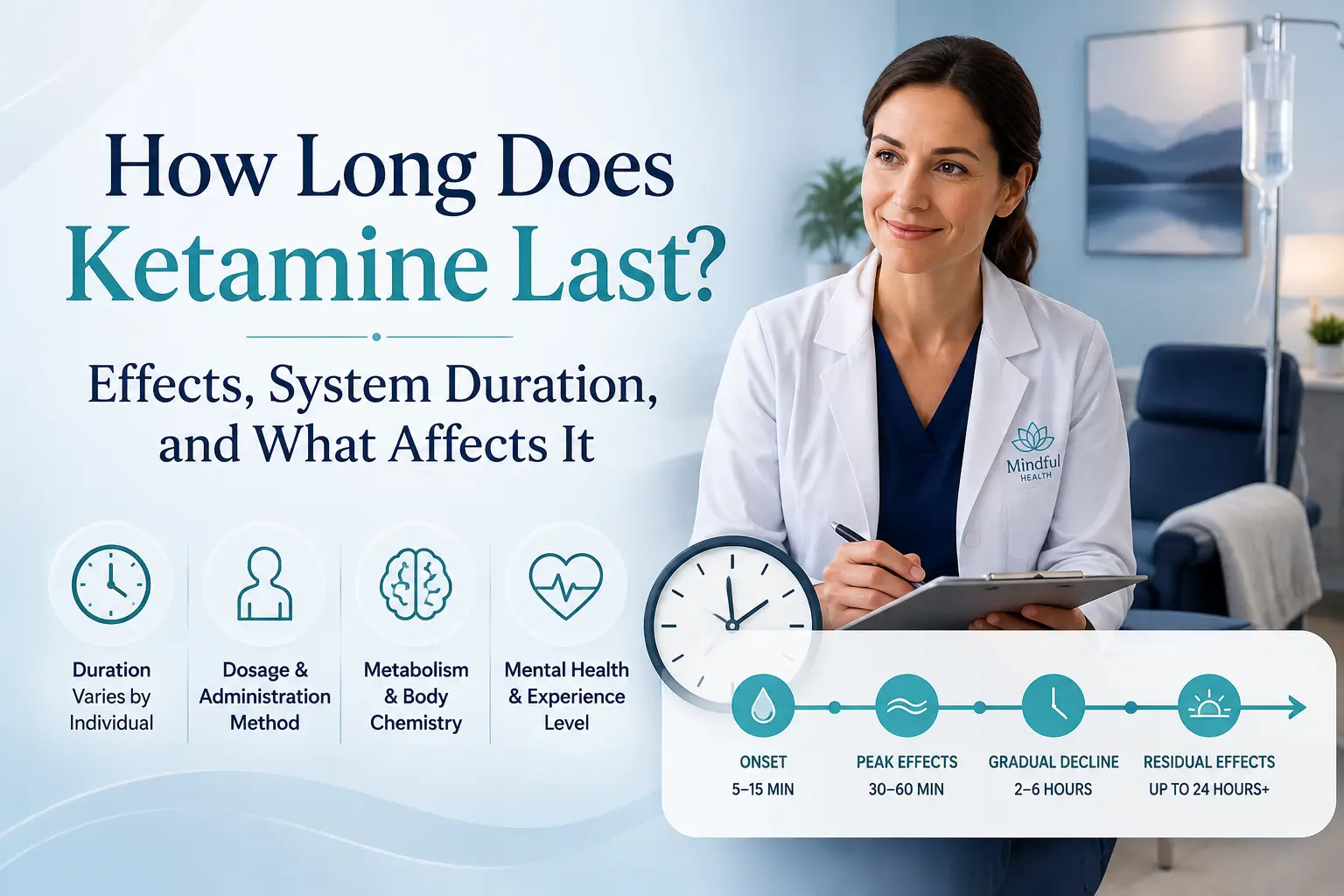
Understanding how long the effects of a session typically last and how many sessions other conditions like depression usually require can help set realistic expectations, since complex PTSD often calls for a similar multi-session approach rather than a single treatment.
Who Is a Good Candidate for Ketamine Therapy?
Good candidates for ketamine therapy are generally adults with complex PTSD who have not found sufficient relief through therapy or medication alone and who do not have specific medical contraindications.
A thorough evaluation is the only reliable way to know if it is a fit for you.
Ketamine therapy is typically not recommended for people with a history of psychosis, uncontrolled high blood pressure, certain heart conditions, active substance use disorder, or pregnancy.
This is exactly why a full medical and psychiatric screening comes before any treatment decision, rather than a one-size-fits-all approach.
Ketamine Therapy for Complex PTSD at AZ Wellness Center in Mesa
At AZ Wellness Center, we know that arriving at this point often means you have already tried a lot and still feel exhausted, frustrated, or unsure where else to turn.
That is not a failure on your part.
Complex PTSD is not a sign of weakness, and finding the right treatment sometimes just takes a different approach.
Our ketamine therapy program is delivered in a safe, comfortable, medically supervised environment, with an initial evaluation to determine whether ketamine is appropriate for your specific history and symptoms.
We look at complex PTSD as part of your whole picture, which is why our mental wellness care considers how trauma, anxiety, mood, and physical health all connect.
If you are in Mesa, Arizona or anywhere in the greater Phoenix and East Valley area and have been searching for a provider who takes complex PTSD seriously, we would like to talk with you about whether ketamine therapy makes sense for your situation.
FAQs: Ketamine for Complex PTSD
Is ketamine effective for complex PTSD?
Research on ketamine for PTSD shows meaningful symptom reduction for many patients, particularly when combined with psychotherapy, though results vary by individual and complex PTSD specifically still needs more dedicated study.
How is complex PTSD different from regular PTSD?
Complex PTSD includes the core symptoms of PTSD plus three additional struggles: trouble regulating emotions, a persistent negative self-view, and difficulty maintaining relationships, typically following repeated or prolonged trauma rather than a single event.
Is ketamine therapy safe for trauma survivors?
Ketamine is generally considered safe in a medically supervised setting, though its dissociative effects require careful screening and monitoring for people with trauma histories, since those effects can sometimes resemble existing dissociative symptoms.
How many ketamine sessions are needed for complex PTSD?
Most protocols involve a series of sessions rather than a single treatment, since research shows repeat dosing produces more consistent and durable results than one infusion alone. Your provider will recommend a specific number based on your evaluation.
What is ketamine-assisted psychotherapy?
Ketamine-assisted psychotherapy combines a ketamine session with structured therapy sessions before and after, using the temporary window of increased neuroplasticity to support trauma processing and integration rather than relying on the medication alone.
Who should not use ketamine therapy?
Ketamine therapy is typically not recommended for people with a history of psychosis, uncontrolled high blood pressure, certain heart conditions, active substance use disorder, or pregnancy. A full medical evaluation determines whether it is appropriate for you.