Ketamine’s dissociative effects usually last 45 minutes to a few hours, depending on the dose and how it’s given, while the drug itself clears from your body within about 10 to 15 hours.
It can still show up on a drug test for days afterward.
If you’re using ketamine for depression, anxiety, or PTSD, the mood benefits often outlast the drug itself by a week or longer.
How long any of this lasts for you depends on your dose, your body, and how the ketamine was administered.
If you’re getting ready for a ketamine session, or you just finished one, the first question on your mind is probably simple: how long does ketamine last?
The honest answer depends on what you’re measuring.
The dissociative, floaty feeling wears off within a few hours for most people.
The drug clears from your bloodstream within about half a day.
But if you’re using ketamine therapy for depression or anxiety, the effects on your mood can stick around for a week or more after the ketamine itself is long gone.
This article breaks down each of those timelines on its own: the immediate effects, how long ketamine stays in your system, how long it can show up on a drug test, and how long the therapeutic benefits actually last.
We’ll also cover what changes those timelines and what to expect if you’re considering ketamine therapy for depression, anxiety, PTSD, or chronic pain.
How Long Does Ketamine Last?
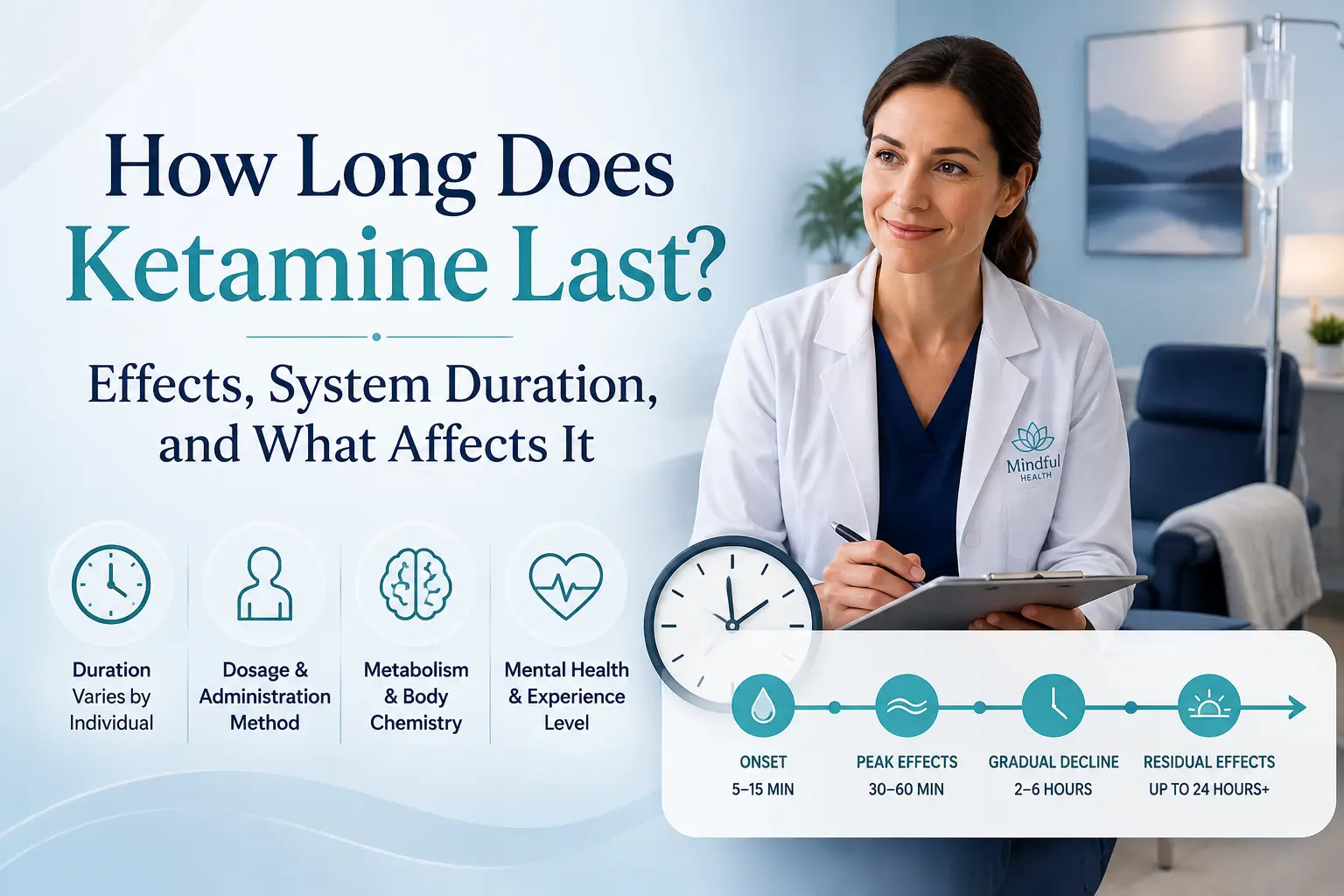
Ketamine’s noticeable effects typically last 45 minutes to a few hours.
A dose taken by mouth or nose can produce effects for 45 minutes up to three hours, while a monitored IV infusion is usually complete within 40 to 60 minutes, with some grogginess lingering for a few hours after.
How long ketamine lasts changes a lot based on how it enters your body and how much you take.
Effects can start within seconds to about 20 minutes depending on the route, and last anywhere from 45 minutes to three hours once they kick in.
A dose taken by mouth or snorted takes longer to reach full effect and tends to stretch out longer too.
An injected or IV dose works almost immediately and wears off faster, which is part of why clinical treatment is usually given this way.
It’s easier for a provider to control and predict.
What Happens During Those First Few Hours?
Let’s take a look at how ketamine works over time:
IV Infusions vs. Nasal Spray (Esketamine)
Clinical ketamine therapy generally comes in two forms: IV (intravenous) racemic ketamine and esketamine nasal spray, sold under the brand name Spravato.
An IV infusion is typically dripped in over 40 minutes to an hour while a provider monitors your heart rate, blood pressure, and how you’re responding.
Esketamine works on a slightly different timeline.
Its elimination half-life runs around 5 hours, a bit longer than IV ketamine, and patients are required to stay at the clinic for at least two hours after each dose so a provider can watch for side effects.
Neither form is meant to be self-administered at home.
Both are given as part of physician-supervised ketamine therapy for the full window when the dissociative effects are strongest.
Common After-Effects and How Long They Linger
Once the strongest effects fade, some after-effects can stick around for a few more hours:
- Mild dizziness or unsteadiness
- Fatigue or grogginess
- Nausea
- Blurred vision or trouble focusing
- Feeling emotionally distant or “foggy”
Most people feel back to normal within three to six hours, though this varies by dose and by person.
Some people feel clear-headed within an hour.
Others need the rest of the day to feel fully like themselves again.
How Long Does Ketamine Stay in Your System?
Ketamine typically clears from your bloodstream within 10 to 15 hours after a dose.
That timeline comes from its half-life, the time it takes your body to break down half the drug, which runs roughly 2 to 4 hours for IV ketamine.
After about four to five half-lives, most of the drug is gone, though trace metabolites can linger in urine for days.
Ketamine’s Half-Life Explained
A drug’s half-life is the time it takes your body to clear half of it from your bloodstream.
For IV ketamine, that’s about 2 to 4 hours in most adults.
Esketamine’s half-life runs a little longer, at roughly 5 hours.
It generally takes four to five half-lives for a drug to be considered fully cleared.
For ketamine, that puts full elimination somewhere between 10 and 20 hours, depending on your metabolism, liver function, and dose.
Your liver does most of the work breaking ketamine down into metabolites, including one called norketamine.
Your body then clears those metabolites mostly through urine over the following days.
How Long Is Ketamine Detectable on a Drug Test?
Ketamine can be detected on a drug test long after its effects wear off.
Saliva tests can pick it up for up to 48 hours, blood tests for one to three days, urine tests for several days up to about two weeks, and hair tests for as long as 90 days after use.
Urine, Blood, Saliva, and Hair Detection Windows
- Saliva: up to 48 hours
- Blood: 1 to 3 days
- Urine: several days up to 2 weeks
- Hair: up to 90 days
These windows can stretch even longer for people who use ketamine frequently or at higher doses, since the drug and its metabolites build up in fatty tissue and take longer to clear.
A single, low-dose clinical infusion tends to clear faster than repeated recreational use.
What Factors Affect How Long Ketamine Lasts?
No two people process ketamine at exactly the same rate.
A handful of factors decide whether you’re back to normal in an hour or still feeling groggy well into the evening:
- Dose: higher doses take longer to clear and tend to produce longer, more intense effects.
- Route: IV and IM doses act faster and clear faster than doses taken by mouth or nose.
- Body weight and metabolism: a faster metabolism generally processes ketamine more quickly.
- Liver and kidney function: since your liver breaks ketamine down and your kidneys help clear the metabolites, any impairment there can extend how long it stays active.
- Frequency of use: regular use lets ketamine and its metabolites build up in the body, which extends both the effects and the detection window.
- Other substances: combining ketamine with alcohol, sedatives, or other drugs can slow clearance and intensify or prolong effects.
The reason you’re using ketamine also shapes the timeline.
Someone managing chronic pain with ketamine often follows a different dosing schedule than someone using it for depression, since pain relief and mood effects don’t always follow the same curve.
How Long Do the Antidepressant Effects Actually Last?
This is where ketamine looks nothing like its physical effects.
A single ketamine infusion’s antidepressant benefits typically last three to fourteen days, even though the drug itself clears from your body within hours.
Repeated sessions, sometimes called stacking, tend to extend that relief to several weeks or longer.
That gap between how long ketamine stays in your system and how long you feel better is one of the more surprising things about this treatment.
Researchers believe part of the answer lies in how ketamine temporarily changes activity at NMDA receptors in a brain region linked to mood, an effect that outlasts the drug’s presence in your bloodstream by days.
A five-year study of patients receiving IV ketamine for treatment-resistant depression found that many needed repeated infusions over time to maintain their improvement, since a single session’s benefits fade.
That’s why most depression and anxiety protocols involve a series of sessions rather than one visit.
Researchers are actively working on stretching that window further.
A 2025 study found it may be feasible to extend a single dose’s benefits from about a week to as long as two months, though that research is still early and hasn’t changed standard treatment protocols yet.
For people working through PTSD, the pattern looks similar.
Relief tends to build across a series of sessions rather than arrive fully formed after just one.
Is It Safe to Drive or Work After a Session?
No.
Most providers recommend avoiding driving for at least 24 hours after a ketamine session, even if you feel completely normal.
Ketamine can affect your reflexes, coordination, and judgment well after the strongest effects wear off, so you’ll need a ride home and a plan to take it easy for the rest of the day.
This isn’t just a formality.
Ketamine can impair reaction time and coordination for hours after the dissociative feeling fades, which is why every session should end with someone else behind the wheel.
Plan to skip strenuous work, big decisions, and anything that needs sharp focus for the rest of that day too.
Most people feel ready to return to normal activities the next morning, but everyone’s timeline is a little different.
How AZ Wellness Center Approaches Ketamine Therapy
At AZ Wellness Center in Mesa, Arizona, ketamine therapy is delivered in a physician-supervised setting rather than a one-size-fits-all protocol.
Your dose, route, and session schedule get built around your health history, your goals, and how you respond to the first few sessions.
For patients working through treatment-resistant depression, anxiety, or PTSD, that individualized approach matters.
Dose, body chemistry, and the condition being treated all shape how long you’ll feel the effects and how many sessions you’ll need.
Ketamine therapy at AZ Wellness Center is offered as part of a broader mental wellness plan rather than a standalone fix.
Many patients pair it with therapy or lifestyle changes to help the benefits last longer between sessions, and many notice improvements in mood, energy, and clarity within the first few sessions, often before a full course of treatment is complete.
The Bottom Line: How Long Does Ketamine Last
How long ketamine lasts really depends on which clock you’re watching: the hours until the dissociative effects fade, the day or so until it clears your system, or the days and weeks its mood benefits can carry.
If you’re considering ketamine therapy for depression, anxiety, PTSD, or chronic pain, AZ Wellness Center in Mesa, Arizona builds each protocol around your body and your goals, not a generic timeline.
Book a consultation to talk through what a personalized plan could look like for you.
FAQs: How Long Does Ketamine Last
How long does a ketamine infusion session take?
A typical IV ketamine infusion runs 40 minutes to an hour, plus monitoring time afterward. Esketamine nasal spray sessions are shorter, but you’ll still need to stay at the clinic for at least two hours of observation before you can leave.
How long until ketamine starts working for depression?
Many patients notice a shift in mood within 24 hours of their first session, much faster than traditional antidepressants, which can take weeks. Lasting improvement usually takes a series of sessions rather than just one.
Can you fail a drug test days after a ketamine treatment?
Yes. Even though the effects wear off in a few hours, ketamine and its metabolites can still show up on a urine test for several days to about two weeks, and even longer on a hair test.
Does esketamine (Spravato) last as long as IV ketamine?
Esketamine has a slightly longer half-life, around 5 hours compared to 2 to 4 hours for IV ketamine, but both require a supervised observation period of at least two hours after dosing.
Why do the antidepressant effects last longer than the drug itself?
Ketamine appears to trigger changes in brain activity that outlast its presence in your bloodstream, which is why mood benefits can last days to weeks after the drug itself has fully cleared.
How many ketamine sessions do most people need?
There’s no universal number. Some people notice benefits from their first session, while others need a series of infusions over several weeks before the effects become noticeable and lasting. Your provider adjusts your schedule based on how you respond.