Ketamine therapy is being studied as a possible option for obsessive-compulsive disorder, particularly when symptoms remain severe despite established treatment.
Small studies suggest that some people may experience rapid, short-term reductions in obsessive thoughts or compulsive urges.
However, results vary, long-term benefits remain uncertain, and researchers have not established a standard ketamine protocol for OCD.
Ketamine should therefore be viewed as an emerging option rather than a replacement for exposure and response prevention therapy, appropriately managed medication, or care from an OCD-trained mental health professional.
What Is Obsessive-Compulsive Disorder?
Obsessive-compulsive disorder, or OCD, is a mental health condition involving obsessions, compulsions, or both.
Obsessions are recurring, unwanted thoughts, images, sensations, or urges that cause distress.
They may involve contamination, harm, health, morality, relationships, sexuality, religion, mistakes, or the feeling that something is incomplete or not “just right.”
Compulsions are behaviors or mental acts a person feels driven to perform to reduce distress or prevent a feared outcome.
Examples may include:
- Repeated washing or cleaning
- Checking locks, appliances, messages, or physical symptoms
- Counting or repeating certain actions
- Reviewing conversations or memories
- Asking other people for reassurance
- Mentally neutralizing an unwanted thought
- Avoiding people, objects, places, or situations
- Repeating an action until it feels correct
Compulsions may create temporary relief, but that relief reinforces the OCD cycle.
The obsession returns, anxiety increases, and the person feels pressured to perform the ritual again.
OCD is not the same as being organized, particular, or cautious.
Symptoms can consume significant amounts of time and interfere with work, school, sleep, relationships, and everyday responsibilities.
Does Ketamine Help OCD?
Ketamine therapy may help reduce OCD symptoms in some people, but it does not work consistently enough to be considered a predictable standalone treatment.
Researchers became interested in ketamine for OCD after small studies reported rapid reductions in obsessive thoughts.
In certain trials, some participants noticed improvement during treatment or within the following hours and days.
Other studies found less substantial changes, especially among people with more complicated or severe treatment histories.
A 2026 systematic review examined five clinical studies, including three randomized controlled trials and two open-label trials.
Across those studies, researchers reported improvements in overall OCD symptom severity, but the duration of the effects ranged from a few hours to six weeks.
The studies also used different administration routes and treatment schedules, making it difficult to determine which approach is most effective.
The current evidence is encouraging, but it remains limited by small study populations, inconsistent protocols, short follow-up periods, and differences between participants.
Ketamine for Treatment-Resistant OCD
Treatment-resistant OCD generally refers to symptoms that have not improved enough after appropriate evidence-based care.
There is no single definition used in every clinical setting.
Before describing OCD as treatment-resistant, a clinician may review whether the person has:
- Worked with a therapist trained in OCD
- Completed a structured course of ERP
- Tried appropriate medications at adequate doses
- Taken each medication for a sufficient amount of time
- Combined medication with therapy when appropriate
- Addressed conditions that could interfere with treatment
- Been able to participate consistently in care
Treatment may also be difficult to continue because of side effects, cost, limited access to OCD specialists, or the intensity of the symptoms.
Ketamine is most commonly discussed in OCD research when symptoms remain severe after established approaches have not provided enough improvement.
Even then, it should be considered within a broader treatment plan rather than as an automatic next step.
How Might Ketamine Affect OCD Symptoms?
Ketamine works differently from the medications traditionally used for OCD.
Researchers are particularly interested in how it affects glutamate, neuroplasticity, and the brain circuits involved in repetitive thoughts and behaviors.
Glutamate and NMDA receptors
Glutamate is a chemical messenger that helps brain cells communicate.
Ketamine blocks a type of glutamate receptor known as the N-methyl-D-aspartate, or NMDA, receptor.
Research suggests that glutamate-related pathways may play a role in OCD.
This does not mean that OCD is caused by a simple glutamate imbalance.
The condition involves a complex interaction between genetics, brain function, behavior, learning, stress, and environmental factors.
Ketamine’s effect on glutamate is one reason researchers are investigating it for people who have not responded adequately to treatments that primarily affect serotonin.
Neuroplasticity and rigid behavioral patterns
Neuroplasticity is the brain’s ability to form and reorganize connections.
OCD can involve deeply reinforced patterns.
An intrusive thought creates distress, the person performs a compulsion, and the temporary relief teaches the brain to repeat that response in the future.
Researchers are exploring whether ketamine may temporarily create greater flexibility in some of these patterns.
A person might feel less emotionally overwhelmed by an obsession or more able to resist a ritual.
However, phrases such as “rewiring” or “resetting” the brain oversimplify the science.
Research has not shown that ketamine permanently changes the brain circuits responsible for OCD.
Anxiety, mood, and obsessive distress
Ketamine may also affect depression, anxiety, and emotional distress.
This matters because OCD often occurs alongside depression or severe anxiety.
Improving mood may make it easier for someone to function, attend therapy, or complete daily tasks.
However, relief from depression does not necessarily mean that obsessions and compulsions will improve to the same extent.
What the Research Still Cannot Tell Us
Although the evidence has grown, several important questions remain unanswered:
- Who is most likely to respond?
- Do certain OCD themes respond better than others?
- Does ketamine primarily improve obsessions, compulsions, depression, or general distress?
- Which administration method is most effective?
- Is one treatment useful, or are repeated sessions needed?
- What dose provides the best balance between potential benefit and tolerability?
- How long does symptom improvement usually last?
- What are the effects of long-term maintenance treatment?
- Does ketamine improve a person’s ability to complete ERP?
- How should other medications be managed?
- What are the risks of repeated treatment over months or years?
A 2026 scoping review similarly concluded that the evidence remains preliminary and varied.
Most trials have examined single administrations, while relatively little research has evaluated repeated treatment with long-term follow-up.
How Quickly Does Ketamine Work for OCD?
Some participants in clinical studies noticed changes in obsessive thoughts during treatment or within several hours.
Others experienced improvement over the following days.
A person who responds might notice:
- Intrusive thoughts feel less emotionally intense
- Obsessions pass more easily
- The urge to perform a ritual feels less powerful
- Anxiety decreases
- It becomes easier to redirect attention
- Participation in therapy feels more manageable
Other people may experience an improvement in depression without a significant change in OCD symptoms.
Some notice no meaningful benefit.
A rapid response in research does not mean everyone will feel better after one session.
Response time may be influenced by symptom severity, co-occurring conditions, current medications, treatment method, and individual sensitivity to ketamine.
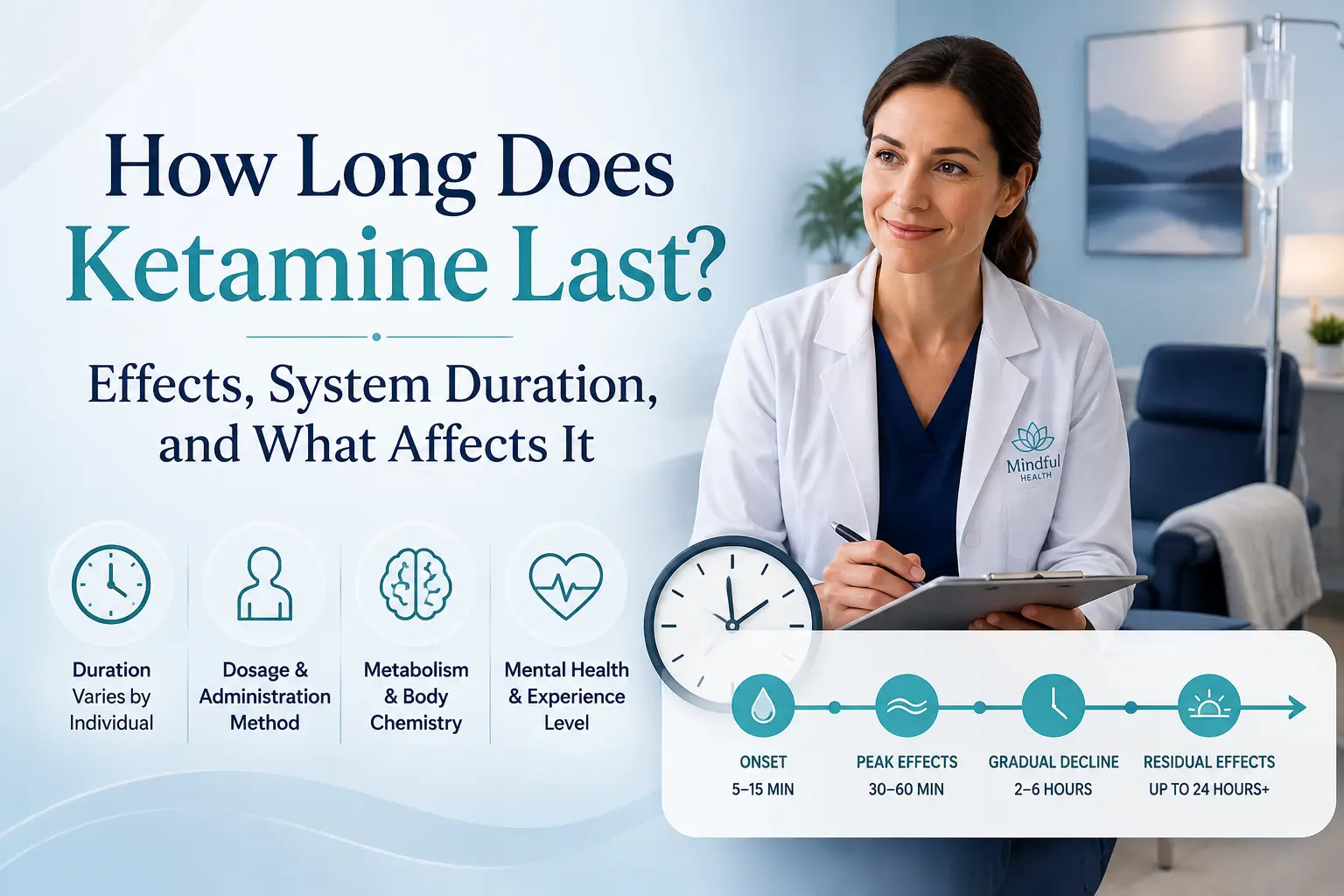
How Long Do the Effects of Ketamine for OCD Last?
The duration of improvement varies considerably.
In early studies, some participants experienced benefits for several days or approximately one week after one infusion.
The 2026 systematic review found that reported effects across five studies ranged from a few hours to six weeks.
These findings do not establish that relief will last for months or years.
Longer effects in some studies may also reflect repeated treatment rather than one administration.
Before beginning treatment, patients should understand:
- How their symptoms will be measured
- When progress will be reviewed
- What will happen if symptoms do not improve
- When additional treatment may or may not be considered
- How ongoing therapy will fit into the plan
- Which side effects or changes should be reported
A treatment schedule used for depression should not automatically be assumed to be the correct approach for OCD.
Can Ketamine Help Intrusive Thoughts?
Ketamine may reduce the frequency or emotional intensity of intrusive thoughts for some people.
It should not be expected to eliminate every unwanted thought.
Most people experience occasional strange, upsetting, or unwanted thoughts.
With OCD, the thought may feel unusually significant, dangerous, immoral, or urgent.
The person then analyzes it, avoids a trigger, seeks reassurance, or performs a ritual.
Someone who responds to ketamine might notice:
- More distance between the thought and their reaction
- Less anxiety when the thought appears
- A reduced need to determine what the thought “means”
- Less urgency to seek certainty
- Greater ability to let the thought pass
- More willingness to resist a compulsion
The goal of OCD treatment is generally not to prevent every intrusive thought.
It is to change the person’s response so the thought no longer controls behavior or requires a ritual.
Can Ketamine Reduce Compulsions?
Ketamine may reduce the distress or obsessive intensity that drives compulsions, but it does not automatically undo learned behaviors.
For example, someone may feel less anxious about contamination but still wash their hands automatically.
Another person may experience less fear about making a mistake but continue checking because the behavior has become habitual.
This is why symptom relief and behavioral treatment may serve different purposes.
Ketamine may temporarily change the intensity of the experience, while ERP helps the person practice responding without rituals.
Ketamine and ERP Therapy for OCD
Exposure and response prevention is a specialized form of cognitive behavioral therapy and remains one of the most established treatments for OCD.
During ERP, a person gradually faces thoughts, sensations, objects, or situations that trigger OCD.
They then practice not completing the usual compulsion.
Over time, the person learns that:
- Anxiety can decrease without performing a ritual
- Uncertainty can be tolerated
- Intrusive thoughts do not require immediate action
- Feared outcomes are often less likely or manageable
- Compulsions do not provide lasting protection
Researchers have explored whether ketamine could support ERP by temporarily reducing obsessive distress or increasing psychological flexibility.
A small study of ketamine-augmented ERP found a rapid reduction in symptoms after ketamine, but the acute effect did not consistently remain when ketamine was used alone.
The researchers suggested that behavioral therapy may be important for extending change beyond the medication’s short-term effects.
Ketamine does not teach ERP skills.
Someone considering both treatments should ideally work with an OCD-trained therapist who can coordinate care and help translate any temporary symptom relief into behavioral progress.
Is Ketamine a Replacement for OCD Medication?
Ketamine should not be used as a reason to suddenly stop an OCD medication.
Serotonin reuptake inhibitors and clomipramine are among the medications commonly used for OCD.
Medication treatment for OCD may require different doses and longer trials than treatment for depression.
Before deciding that a medication has not worked, a prescriber may review:
- The medication and dose
- How long it was taken
- Whether doses were missed
- Side effects
- Other medications or substances
- Changes in depression and anxiety
- Whether ERP was completed at the same time
- Whether the OCD diagnosis or a co-occurring condition needs further evaluation
Medication should only be reduced, discontinued, or changed under the direction of the clinician managing it.
What If Someone Has Both OCD and Depression?
OCD and depression frequently occur together.
Severe OCD can contribute to exhaustion, isolation, hopelessness, and loss of daily functioning.
Depression may also make it harder to attend therapy or complete exposure exercises.
Ketamine has a larger research base for treatment-resistant depression than for OCD.
As a result, a clinician may consider ketamine primarily for depression in someone who also has OCD.
Patients should ask whether the intended treatment target is:
- Core OCD symptoms
- Depression
- Suicidal thoughts
- Trauma-related symptoms
- Severe anxiety
- More than one condition
An improvement in energy, hope, or mood may be meaningful, but it should not automatically be recorded as an improvement in obsessions or compulsions.
Potential Benefits of Ketamine for OCD
Based on early research, possible benefits for a person who responds may include:
- Rapid reduction in obsessive distress
- Less emotional intensity around intrusive thoughts
- A weaker urge to perform compulsions
- Improved mood when depression is also present
- Greater ability to participate in therapy
- Better daily functioning
- A temporary opportunity to practice new behavioral responses
These are potential outcomes rather than guaranteed results.
Ketamine may help one symptom while leaving another unchanged, and some people do not experience a meaningful response.
What Does Ketamine Therapy Feel Like?
The experience varies based on the dose, administration method, environment, and individual.
During treatment, a person may feel:
- Physically light or heavy
- Dreamlike or deeply relaxed
- Detached from their body
- As though time is moving differently
- More aware of sounds, colors, or internal sensations
- Dizzy or sleepy
- Emotionally open
- Nauseated
- Anxious or uncomfortable
Dissociation is a temporary change in a person’s sense of their body, surroundings, time, or identity.
For some people, it feels neutral or calming.
For others, particularly those who fear losing control or becoming disconnected from reality, it may be distressing.
Someone whose OCD centers on bodily sensations, mental stability, or control should discuss those concerns during screening.
What to Expect Before Ketamine Therapy
A medical and mental health screening should occur before treatment.
The provider may ask about:
- Current OCD symptoms
- Depression, anxiety, trauma, mania, or psychosis
- Previous mental health treatment
- Current and past medications
- Alcohol and substance use
- Blood pressure and cardiovascular health
- Liver, kidney, bladder, or urinary concerns
- Pregnancy or breastfeeding
- Previous experiences with ketamine or anesthesia
- Current therapy and psychiatric care
- Transportation after the appointment
The consultation should also establish realistic and measurable goals.
Examples may include:
- Spending less time checking
- Reducing reassurance seeking
- Returning to work or school
- Completing ERP exercises more consistently
- Resuming activities that OCD has restricted
- Experiencing less distress when intrusive thoughts appear
- Improving sleep or daily functioning
What Happens During a Ketamine Session?
The process depends on the route of administration and the clinic’s protocol.
Before treatment, the care team may check vital signs and review how the patient is feeling that day. During treatment, the patient remains in a supervised setting while ketamine is administered.
Monitoring may include:
- Blood pressure
- Heart rate
- Oxygen levels
- Responsiveness
- Physical and emotional comfort
The effects generally begin during or shortly after administration.
Although the strongest effects usually decrease as the session ends, coordination, judgment, balance, and reaction time may remain affected.
Patients should follow the clinic’s instructions about fasting, medications, driving, alcohol, work, exercise, and other activities before and after treatment.
Transportation home is generally required.
Potential Side Effects and Risks
Short-term side effects may include:
- Dissociation
- Dizziness
- Nausea or vomiting
- Sleepiness
- Headache
- Blurred or altered vision
- Increased blood pressure
- Increased heart rate
- Changes in the perception of sound, color, space, or time
- Anxiety
- Confusion
- Difficulty concentrating
- Poor coordination
In the newer intramuscular OCD study, dissociation and cardiovascular changes were generally temporary, but some participants found the experience difficult to tolerate.
Frequent or heavy ketamine use outside medical care has been associated with misuse, dependence, cognitive problems, liver injury, and urinary or bladder complications.
A supervised medical setting does not eliminate every risk, which is why careful screening and ongoing reassessment matter.
Ketamine vs. Esketamine for OCD
Ketamine and esketamine are related, but they are not identical.
Racemic ketamine contains two mirror-image forms of the ketamine molecule.
Esketamine contains one of those forms.
Most of the frequently cited OCD studies examined racemic ketamine delivered intravenously or intramuscularly.
Other research has evaluated oral or intranasal approaches, but the evidence is smaller.
Results from one form or route should not automatically be applied to another.
Patients should ask:
- Which medication is being used?
- How will it be administered?
- What condition is being treated?
- What evidence supports that approach?
- How will symptoms and side effects be measured?
Considering Ketamine When You Have OCD in Arizona
AZ Wellness Center offers medically supervised IV ketamine therapy in Arizona.
Someone who has OCD should use the consultation to clarify:
- Whether OCD itself or a co-occurring condition is being evaluated
- Whether ketamine is appropriate based on their history
- How the center will communicate with their therapist or psychiatrist
- How symptoms will be measured
- What treatment process and monitoring are provided
- What happens if treatment does not produce a meaningful response
A consultation does not guarantee that someone will be considered an appropriate candidate.
Because ketamine research for OCD is still developing, patients should receive balanced information about potential benefits, risks, alternatives, and uncertainties.
Final Thoughts on Ketamine for OCD
Ketamine is an emerging area of OCD research.
Recent studies and reviews suggest that it may rapidly reduce obsessive-compulsive symptoms in some people, particularly when symptoms have not improved enough with established treatment.
The evidence is not yet strong enough to predict who will respond, how long improvement will last, or which treatment schedule works best.
Ketamine should not be presented as a cure or a replacement for ERP, appropriately managed medication, or specialized mental health care.
People considering ketamine should receive a complete medical and mental health evaluation, understand the potential side effects, and ask how treatment will fit into their existing OCD care.
AZ Wellness Center provides medically supervised ketamine therapy in Arizona.
A consultation can help determine whether ketamine may be appropriate for the condition being treated and what the screening, monitoring, and follow-up process involves.
FAQs: Ketamine for OCD
Does ketamine work for OCD?
Ketamine may reduce OCD symptoms for some people, but results are not consistent. Small studies and recent reviews have reported rapid improvement in certain participants, while researchers still do not know how reliably the benefits last or who is most likely to respond.
How fast does ketamine work for OCD?
Some study participants reported changes during treatment or within several hours. Others noticed improvement during the following days, and some experienced no meaningful change.
Can ketamine be combined with ERP?
Ketamine and ERP may be used together in some circumstances, but this is still an area of research. Ketamine does not replace ERP or teach the behavioral skills needed to respond differently to obsessions.
What are the benefits of ketamine?
Potential benefits of ketamine may include rapid improvements in mood, reduced emotional distress, and greater ability to participate in therapy. Early OCD research also suggests that some people may experience less intense intrusive thoughts or compulsive urges. Results vary, and ketamine does not provide meaningful improvement for everyone.
Can ketamine help with mental health?
Ketamine may help certain people with mental health concerns, particularly when previous treatments have not provided enough relief. It has a larger research base for treatment-resistant depression than for OCD. A qualified provider should determine which condition is being treated and whether ketamine is appropriate for the individual.
How long does ketamine take to work?
Some people notice changes during treatment or within several hours, while others may experience improvement over the following days. In OCD studies, certain participants reported rapid reductions in obsessive distress, but others experienced little or no benefit. The response time depends on the condition being treated, the administration method, and the individual.